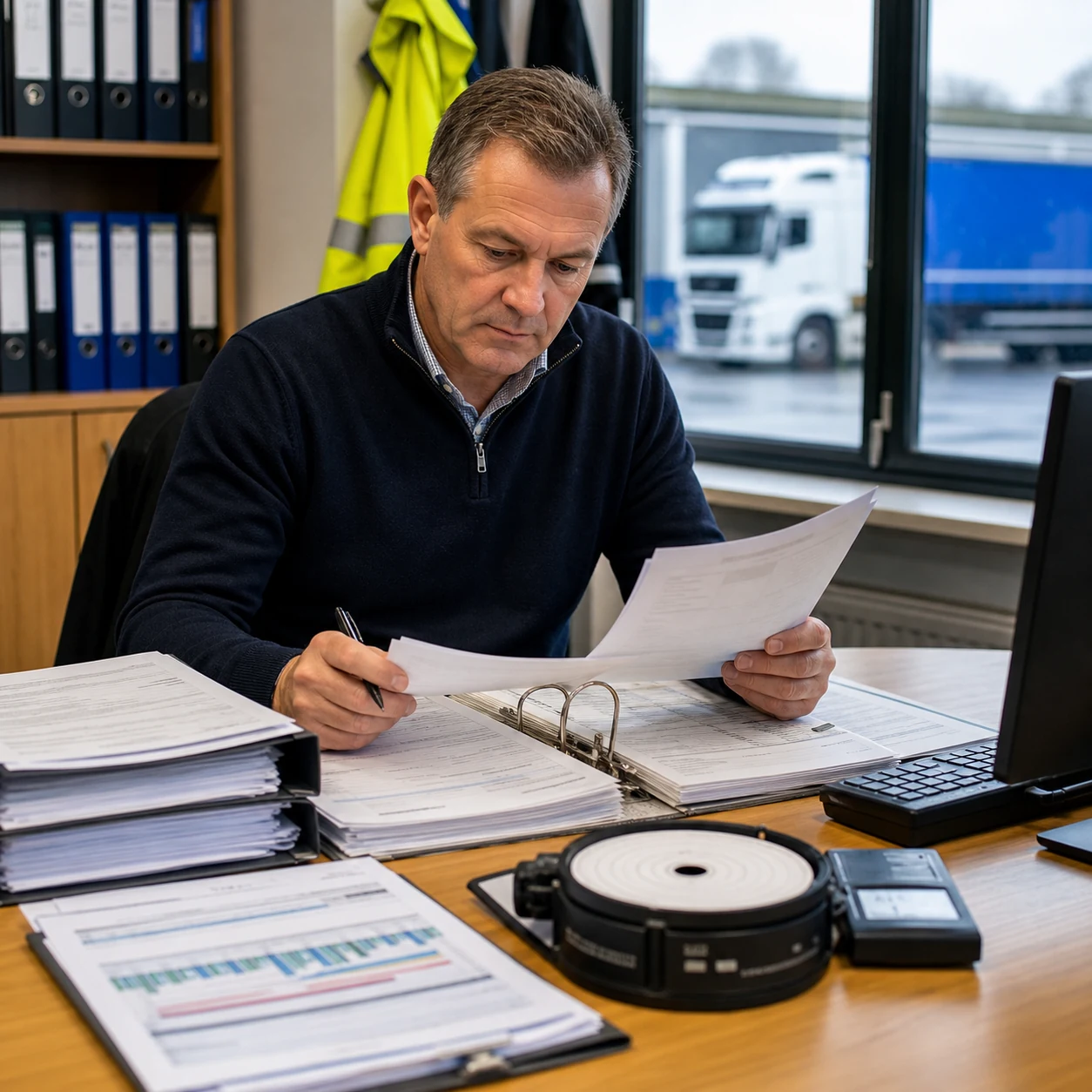
Operator licence compliance is the evidence that your business is controlling roadworthiness, maintenance, drivers’ hours, defect reporting and transport management in a way that would stand up if DVSA or the Traffic Commissioner asked to see it. Telling drivers to stay legal and hoping the vehicles keep moving is not a system.
The official GOV.UK goods vehicle operator licensing guide explains that goods vehicle licences are granted on undertakings given by the applicant. Those undertakings are not background paperwork. They are the promises the operator is expected to keep, and regulatory action can follow if they are not met.
For many operators, the danger is not a single dramatic failure. It is a slow drift: a missed PMI, an unclosed defect, a weak brake test file, a Transport Manager who is named on VOL but has little visible evidence of control. That is why a good compliance system has to be repeatable, documented and actively reviewed.
What the Traffic Commissioner is likely to look for
At a DVSA investigation, desk-based review or public inquiry, the question is rarely limited to whether one breach happened. The more important question is whether the management system should have prevented it, identified it earlier or corrected it properly afterwards.
A verbal explanation may help, but it will not replace records. If the business says maintenance is planned, there should be a current planner and completed preventive maintenance inspection records. If defects are reported, there should be evidence that they were assessed, repaired and closed. If a Transport Manager is responsible for continuous and effective management, there should be visible review activity, not a name on the licence and little else.
Compliance records operators should be able to produce
The table below is a practical self-check. It is not a complete legal list, but it reflects the kind of evidence that often decides whether an operator appears controlled or reactive.
| Compliance area | What good evidence shows | Common weakness |
|---|---|---|
| PMI and maintenance planning | Inspection dates are planned, completed on time and reviewed against the stated interval. | Intervals drift, missed inspections are explained late, or paperwork is incomplete. |
| Driver defect reporting | Defects are reported, assessed, repaired where needed and signed off before use. | Reports exist but nobody can prove who reviewed them or what action followed. |
| Brake testing | Brake performance is checked using appropriate records and any poor result is followed up. | Records are kept but not understood, reviewed or linked to corrective action. |
| Drivers’ hours and tachographs | Downloads, infringement checks and driver follow-up are recorded and acted on. | Reports are printed or stored but repeated infringements are not managed. |
| Transport Manager control | The TM can show audits, KPI checks, meeting notes or other evidence of active oversight. | The TM arrangement exists on paper but looks detached from day-to-day operation. |
DVSA’s Guide to Maintaining Roadworthiness should be read alongside any internal maintenance process. The guide is the official reference point; your own records are the evidence that the process is actually happening.
Management control: sampling, escalation and closing the loop
Holding the records is the starting point. The Traffic Commissioner and DVSA increasingly look for evidence that a competent person is sampling what comes in, escalating issues that recur and closing them out in writing. A Transport Manager who signs off a folder once a month with no comment is not exercising the continuous and effective control the licence requires.
Practical sampling means taking a small number of PMI sheets, defect reports, brake test printouts and driver tachograph files each period, and recording what was reviewed, what was found and what changed as a result. Where the same issue appears twice, the question is no longer about that vehicle or driver. It is about whether the system has a known weakness and whether the operator has owned it. An action log with dates, owners and completion notes is what converts that ownership into evidence.
“The operators who come through scrutiny well are rarely the ones with the thickest folders. They are the ones whose Transport Manager picks a sample each period, a few PMI sheets, a driver’s tachograph file, a defect from the previous week, and writes down what they found and what they changed. That sampling habit is what turns a stack of paper into proof of control.”
Liam Gafoor CMILT IOSH, Operator Licence Ltd
Director awareness and accountability
Where a company holds the licence, directors are expected to know what is happening. At a public inquiry it is uncomfortable for a director to say maintenance and driver matters are entirely the Transport Manager’s problem. The Traffic Commissioner expects the board or owner to receive a regular compliance report, ask questions about the answers and act when something looks off.
A short monthly report is usually enough, provided it is read, signed and challenged. Useful headline figures include PMI on-time rate, MOT first-time pass rate, prohibitions and roadside encounter outcomes, defect close-out times, tachograph infringements per driver and any open Transport Manager actions. If a director cannot answer a basic question about any of those numbers, the file does not show director awareness, regardless of what is in the maintenance cabinet.
A practical pattern seen in weak compliance files
A common anonymised pattern is a small operator with vehicles inspected by a third-party workshop. The inspections are happening, invoices are paid and the vehicles look presentable, but the operator cannot show a controlled planner, defect close-out trail or regular review of inspection quality. When one roadside prohibition occurs, the file suddenly looks much weaker than the operator expected because the records do not prove management control.
The lesson is simple but important: outsourcing maintenance does not outsource the operator’s responsibility. The licence holder still needs to know whether inspections are on time, whether defects are being fixed, whether brake test results make sense and whether the workshop paperwork is good enough.
Why “following the law” is not always enough
Operators sometimes focus on the visible rules: speed, load security, drivers’ hours and whether a vehicle has been stopped. Those things matter, but operator licensing is also about fitness, repute, financial standing, operating centre control and keeping the undertakings attached to the licence. A business can avoid obvious offences for a period while still running a weak system behind the scenes.
This is where many files become uncomfortable. If a defect repeats, who spotted the trend? If drivers keep generating tachograph infringements, who briefed them and recorded the action? If PMI sheets contain the same vague comments month after month, who challenged the maintenance provider? Compliance is not proved by having paperwork in a folder. It is proved by showing that somebody competent is reading it, acting on it and closing the loop.
How to strengthen operator licence compliance before scrutiny
Start with the licence undertakings and compare them with the operation as it runs today. Check the authorised vehicles and trailers, operating centre, Transport Manager arrangement, maintenance provider details, inspection intervals, driver control and record retention. If anything has changed, deal with it before it becomes an explanation under pressure.
Then test the evidence chain. Pick one defect, one PMI, one brake test, one tachograph infringement and one Transport Manager review. For each item, ask whether the record shows what happened, who made the decision, what action followed and when it was closed. If the answer depends on memory, the evidence is not strong enough.
Our pages on maintenance recording checks and maintenance and planning explain how to review the record side. If the issue is already serious, our Traffic Commissioner hearings page covers the route operators may face when compliance concerns have escalated.
Operator Licence Ltd can help review this evidence, identify the gaps and connect you with the right specialist support for Transport Manager sampling, director-level reporting and repeat-issue closure.
FAQ
Is operator licence compliance just about avoiding offences?
No. Avoiding offences matters, but operators also need working systems, records and management control that show the licence undertakings are being kept.
What should operators review first?
Start with maintenance planning, defect close-out, brake testing, tachograph infringement follow-up and evidence of Transport Manager oversight.
Can a Traffic Commissioner take action if records are weak?
Yes. Weak records can make it difficult to prove that vehicles are roadworthy and that the operator is exercising proper control, especially if DVSA has already identified concerns.
Does using an external workshop remove the operator’s responsibility?
No. The operator remains responsible for ensuring the maintenance system works and that workshop records, inspection intervals and defect action are properly controlled.
What should a director receive each month?
A short compliance report covering PMI on-time rate, prohibition and roadside outcomes, defect close-out time, tachograph infringements per driver and any open Transport Manager actions. The director should read it, query anything unusual and record the response.