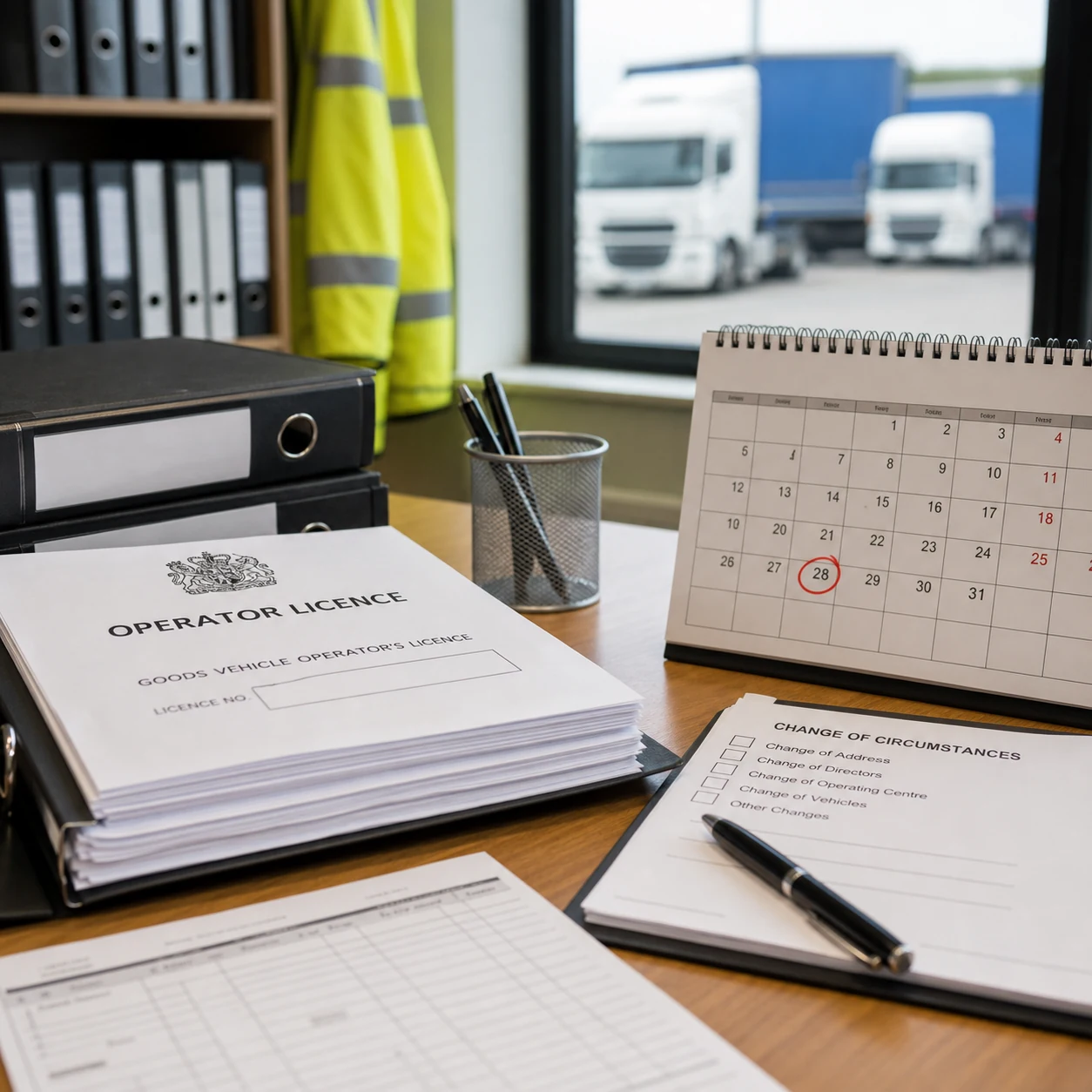
Traffic Commissioner public inquiry preparation should start as soon as the call-up letter arrives. A public inquiry is a formal hearing used to gather evidence before decisions are made about an operator licence. It is not the place to discover that maintenance records are missing, director oversight is unclear or the Transport Manager cannot explain the current system.
The best preparation is not a large, untidy file. It is a clear account of the concern, the evidence behind it, what went wrong, what has changed and who now checks compliance. GOV.UK explains the Traffic Commissioner role and public inquiry process; this page focuses on the practical evidence an operator should assemble before the hearing.
Start with the call-up letter and a chronology
Read the call-up letter line by line and list each concern separately. Do not treat it as a general complaint about the business. If the letter refers to maintenance, drivers’ hours, financial standing, Transport Manager control or previous undertakings, each issue needs its own evidence trail.
Then build a plain chronology. When did the problem start? When was it identified? Who knew? What was done? When was it checked again? A strong chronology separates historic failings from current control. That distinction matters because the Traffic Commissioner will usually want to understand both the cause of the problem and whether the operator can now be trusted to comply.
Public inquiry evidence checklist
The exact bundle depends on the case, but most operator licence hearings turn on a small number of recurring evidence areas. The table below is a practical starting point.
| Evidence area | What to prepare | Common weakness |
|---|---|---|
| Maintenance control | PMI sheets, maintenance planner, brake test evidence, defect reports, contractor reviews and evidence of follow-up. | Records exist but defects are not closed, brake evidence is weak or intervals have drifted. |
| Transport Manager involvement | Review notes, meeting records, instructions issued, audit findings and evidence of active management. | The TM is named on the licence but has little evidence of continuous oversight. |
| Drivers’ hours and tachographs | Download records, infringement reports, driver debriefs, training records and escalation notes. | Infringements are printed but not acted on or trends are not reviewed. |
| Director oversight | Board or management notes, compliance reports, finance checks and decisions on resources. | Directors rely entirely on others and cannot explain the licence undertakings. |
| Existing undertakings | Copy of licence undertakings, evidence each one is being met, and notes on any variation needed. | The operator cannot quote the current undertakings or show how they are tracked. |
| Corrective action | Dated action plan, completed actions, fresh sample records and named responsibilities. | The plan says what will happen but lacks proof that it is already working. |
Undertakings, old and new
Many operators forget that the licence already carries undertakings agreed at grant or variation. Before the hearing, list each one and place evidence against it: independent audits, financial standing, drivers’ hours systems, defect reporting, operating centre conditions. Where a new undertaking is being offered to address current concerns, write it in plain terms, decide who owns it, and make sure the action log shows it is already running rather than promised. A Traffic Commissioner is more likely to accept a fresh undertaking when the operator can demonstrate it is realistic and already being followed.
Show what has changed since the concern arose
A public inquiry bundle should not only explain the failure. It should show the response. “We have tightened things up” is too vague. A better answer is specific: the inspection interval was reduced, the defect escalation process changed, the maintenance contractor was reviewed, drivers were retrained and the Transport Manager now signs off a monthly compliance sample.
Fresh records are often more persuasive than promises. If the issue was late inspections, include a recent planner and completed inspection sample. If the issue was drivers’ hours, include infringement follow-up notes after the new system started. If the issue was management control, include evidence that the director and Transport Manager are now reviewing the same compliance information.
Keep a single action log
One running action log is more useful than a stack of separate notes. Each row should record the concern raised, the action taken, the date, the person responsible and the evidence reference. The log is then cross-referenced to the bundle, so any item the Traffic Commissioner asks about can be traced quickly. Operators who walk into the hearing with this single document tend to give clearer answers than those flicking between files.
“In the cases I review, the operator who succeeds is rarely the one with the thickest bundle. It is the one whose action log lines up with their evidence, whose Transport Manager can speak to current records without prompting, and whose directors can explain in their own words what changed and why.” Liam Gafoor CMILT IOSH, transport compliance adviser, Operator Licence Ltd.
Practical pattern: the file that explains the past but not the present
A common pattern before inquiry is an operator producing a detailed explanation of the original failure but very little evidence of current control. The file may contain the DVSA report, the workshop invoices and a written apology, yet lack a later sample showing that defects are now closed properly, brake tests are reviewed and Transport Manager checks are recorded.
That gap matters. The Traffic Commissioner is not only looking backwards. The operator must be ready to show what the business looks like now and why the same weakness should not repeat.
Prepare directors and Transport Managers separately
Directors and Transport Managers should prepare together, but they should not rely on one person to answer everything. A director should understand authority, finance, undertakings, governance and resourcing. A Transport Manager should be ready to explain maintenance systems, driver control, tachograph monitoring, defect reporting, contractor management and intervention records.
If either person can only say that an adviser prepared the file, the evidence may appear weak. Advisers can help organise and test the position, but the operator and nominated people still need to understand the systems they are responsible for.
Presentation and bundle control
Presentation will not save a weak case, but poor presentation can damage a better one. Documents should be ordered, dated and easy to navigate. Key records should not be buried among unrelated paperwork. Where a document answers a specific concern, make that connection clear.
Keep copies of what was sent, what was updated and who checked it. If new records become available before the hearing, add them in a controlled way rather than producing a loose pile on the day. A short index at the front of the bundle, pointing each call-up concern to the relevant tab, saves time when the hearing is under way.
What support can help before the hearing
A readiness review can test whether the evidence answers the call-up letter, whether the chronology is clear and whether current records support the corrective action plan. OperatorLicence.co.uk can help review Traffic Commissioner hearings preparation, maintenance evidence, driver control records and wider operator licence compliance before the regulator tests those documents.
Where maintenance is a central issue, review maintenance recording checks early so gaps can be identified before the hearing bundle is finalised.
Public inquiry preparation FAQs
Can a Traffic Commissioner call a public inquiry after compliance concerns?
Yes. A Traffic Commissioner can call a formal hearing when evidence is needed before deciding what action, if any, should be taken in relation to an operator licence.
What should an operator prepare first?
Start with the call-up letter, a chronology and the evidence that answers each concern. Maintenance records, Transport Manager involvement, director oversight, drivers’ hours records, existing undertakings and corrective action are common areas.
Is a corrective action plan enough?
Usually not on its own. A plan is stronger when supported by dated actions, a single action log and fresh records showing the new system is actually being followed.
Should new undertakings be offered before the hearing?
Sometimes. New undertakings should be specific, owned by a named person and already in motion. Offering an undertaking that the operator cannot evidence on the day tends to weaken rather than help the position.