

“ADR signs” is a useful everyday phrase, but it covers several different forms of identification. ADR 2025 has applied since 1 January 2025 and distinguishes package labels and marks under Chapter 5.2, placards and marks used on vehicles, tanks and containers under Chapter 5.3, and special warning marks under Chapter 5.5.
In Great Britain, the Carriage of Dangerous Goods and Use of Transportable Pressure Equipment Regulations 2009, as amended, provide the domestic framework and refer to ADR. The practical question is not simply whether a symbol looks familiar, but what it identifies and which ADR function it performs.
This guide helps operators, drivers and compliance managers recognise common hazard labels, placards and marks. It is identification guidance rather than print-ready artwork or load-specific advice. Correct requirements depend on classification, UN number, quantity, packaging, mode and journey.
Questions that go beyond identification should be considered within the operation’s own compliance arrangements, including its dangerous goods safety adviser provision where relevant.
ADR signs terminology at a glance
| Term | Typical location | Purpose | Common trap |
|---|---|---|---|
| “ADR signs” | Informal wording used for packages, vehicles, tanks, containers and other relevant contexts | A convenient umbrella expression for visible dangerous-goods identification | Assuming a single set of rules applies to everything described by the phrase |
| Hazard label | Typically on packages (Chapter 5.2) | Communicates the hazard class or division of the contents | Treating a package label as if it were automatically the same as a vehicle placard |
| Package mark | Packages (Chapter 5.2) | Provides required identification or special information through prescribed marks | Calling every required mark a “label” and missing the distinction |
| Placard or mark (vehicle/tank/container) | Vehicles, tanks and containers (Chapter 5.3) | Shows hazards or identifiers at transport-unit or equipment level | Copying package-level assumptions directly onto vehicles or tanks |
| Special warning mark | Situations covered by Chapter 5.5 | Highlights specific transport-related warnings outside standard class labels | Reading it as a class label rather than a separate warning category |
How to use this identification guide
- Start with the title and number. ADR labels and related signs are structured, so the class or division reference is central to correct identification.
- Decide the context: package (Chapter 5.2), vehicle/tank/container (Chapter 5.3), or a special warning mark (Chapter 5.5). The same visual idea can serve different functions in different contexts.
- Read what the item identifies in plain terms, then note the operational distinction that separates it from similar-looking categories.
- Avoid assumptions based on colour or symbol alone. Closely related classes share visual cues but have materially different meanings.
- Confirm the actual requirement against classification, UN number, quantity, packaging, mode and journey within your own systems or guidance, such as an internal operator compliance hub.
40 ADR labels, placards and marks explained
1. Division 1.1 explosive label
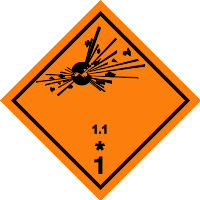
The Division 1.1 explosive label identifies a Class 1 explosive presenting a mass-explosion hazard. This means the hazard can involve the bulk of the explosive material rather than being confined to a limited local effect. The compatibility-group letter is inserted in the lower half of the label and forms part of the identification.
Division 1.1 must not be treated as interchangeable with other Class 1 divisions. Its mass-explosion characteristic sets it apart from Divisions 1.2, 1.3 and 1.4. When reading the label, both the division number and the compatibility-group letter matter; relying only on the general explosive symbol risks misidentification.
2. Division 1.2 explosive label
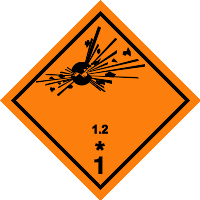
The Division 1.2 explosive label identifies Class 1 explosives with a projection hazard but without a mass-explosion hazard. The defining feature is the potential for projected fragments or articles, rather than a simultaneous explosion of the entire load.
In operational terms, the distinction from Division 1.1 is fundamental. A 1.2 label should not be read as a reduced version of a mass-explosion hazard, and it is also distinct from Division 1.3, where fire is central. Accurate identification depends on reading the division number rather than assuming all explosive labels convey the same risk profile.
3. Division 1.3 explosive label
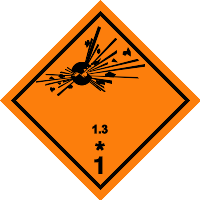
The Division 1.3 explosive label identifies substances and articles with a fire hazard and either a minor blast hazard, a minor projection hazard, or both, but not a mass-explosion hazard. Fire behaviour is therefore central to its meaning.
Division 1.3 occupies a middle position between projection-focused and confined-effect categories. It should not be confused with Division 1.2, where projection is the defining element, or Division 1.4, where effects are largely confined to the package. The absence of a mass-explosion hazard remains a key differentiator from Division 1.1.
4. Division 1.4 explosive label
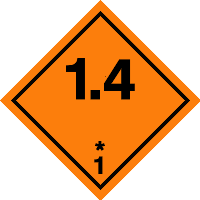
The Division 1.4 explosive label identifies a slight explosion hazard where the effects are largely confined to the package. The description signals limited external impact compared with other Class 1 divisions.
For operational identification, “slight” does not mean negligible. The label distinguishes this division from 1.3, where fire and minor blast effects are more prominent, and from 1.1 or 1.2, where broader hazards exist. The defining point is the confinement of effects, not the absence of risk.
5. Division 1.5 explosive label
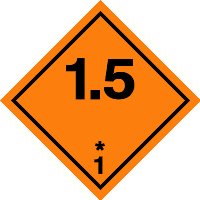
The Division 1.5 explosive label identifies a very insensitive substance that nonetheless has a mass-explosion hazard. Insensitivity relates to how readily the substance can be initiated, not to the scale of consequences if it does explode.
This creates a specific distinction from Division 1.1. While both involve a mass-explosion hazard, Division 1.5 highlights reduced sensitivity to initiation. The label therefore combines two ideas that must be read together: insensitivity in handling terms and significant consequences in the event of explosion.
6. Division 1.6 explosive label
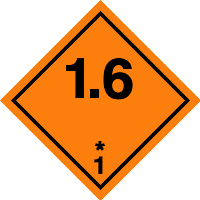
The Division 1.6 explosive label identifies extremely insensitive articles without a mass-explosion hazard. The focus here is on articles rather than substances, and on the absence of a mass-explosion characteristic.
From an operational perspective, this distinguishes Division 1.6 from Division 1.5, where a mass-explosion hazard remains. It also differs from lower divisions by emphasising the combination of extreme insensitivity and limited explosive effect. Reading both elements together is essential for correct identification.
7. Model 2.1 flammable-gas label
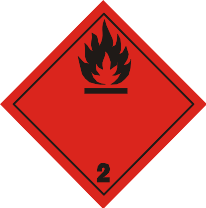
The Model 2.1 flammable-gas label identifies flammable gases and is characterised by the flame symbol on a red background. The class designation confirms that the material is in the gaseous state for classification purposes.
The presence of a flame symbol should not lead to confusion with flammable liquids or solids. The label specifically denotes gases within Class 2. Distinguishing between physical states is important, as similar visual cues are used across different classes with different underlying meanings.
8. Model 2.2 non-flammable, non-toxic-gas label
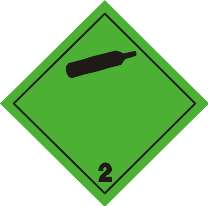
The Model 2.2 non-flammable, non-toxic-gas label identifies gases that are neither flammable nor toxic, shown with a cylinder symbol on a green background. The wording is precise and limited to those two properties.
It should not be interpreted as meaning the gas is harmless. The label only indicates that it does not meet ADR criteria for flammability or toxicity. Other hazards or handling considerations may still apply, so the identification must be read within its defined scope.
9. Model 2.3 toxic-gas label

The Model 2.3 toxic-gas label identifies toxic gases and uses the skull and crossbones symbol to convey acute toxicity. The class assignment places it within gases, but with a distinct hazard emphasis.
In operational terms, the contrast with Model 2.2 is direct. Both are gases, yet the hazard communication differs fundamentally. Accurate identification depends on recognising that the gas category alone is not sufficient; the toxicity designation changes how the label is understood.
10. Model 3 flammable-liquid label
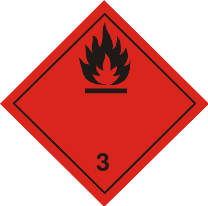
The Model 3 flammable-liquid label identifies flammable liquids and features a flame symbol on a red background. The classification relates specifically to liquids capable of ignition under defined conditions.
The similarity of colour and symbol to other flammable classes requires care. This label should not be confused with flammable gases (Class 2.1) or flammable solids (Class 4.1). The key distinction lies in the liquid state and the criteria used to assign the class.
11. Model 4.1 flammable-solid label

The Model 4.1 flammable-solid label identifies flammable solids, self-reactive substances, polymerising substances and solid desensitised explosives. It therefore covers a broader set of materials than the simple description “flammable solid” might suggest.
This breadth is the main distinction. The label should not be read as applying only to conventional combustible solids. Its scope includes specific reactive and desensitised materials, which differentiates it from the more narrowly defined flammable liquid and gas classes.
12. Model 4.2 spontaneous-combustion label

The Model 4.2 spontaneous-combustion label identifies substances liable to spontaneous combustion or self-heating. The defining feature is the ability to generate heat internally to the point of ignition.
This separates it from other flammable classes where an external ignition source is typically assumed. It is also distinct from Model 4.3, where the hazard arises from contact with water. The trigger for the hazard is therefore a key part of correct identification.
13. Model 4.3 dangerous-when-wet label
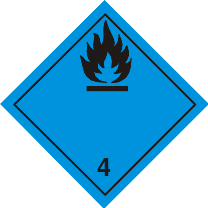
The Model 4.3 dangerous-when-wet label identifies substances that emit flammable gas when in contact with water. The interaction with water is central to the hazard description.
From an operational perspective, this is not simply another flammable classification. The hazard arises through a specific reaction with water, which distinguishes it from substances that are inherently flammable in dry conditions. Recognising that trigger is essential when interpreting the label.
14. Model 5.1 oxidising-substance label
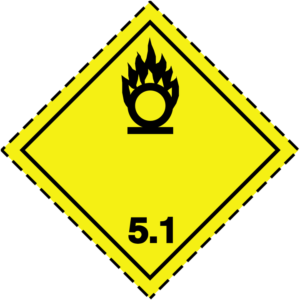
The Model 5.1 oxidising-substance label identifies substances that may cause or intensify fire through an oxidising effect. The mechanism of hazard is therefore different from direct flammability.
This distinction is critical. The label should not be read in the same way as flammable liquid or solid labels, even though fire is involved. The oxidising effect means the substance can contribute to combustion in a different way, which is the key point of identification.
15. Model 5.2 organic-peroxide label
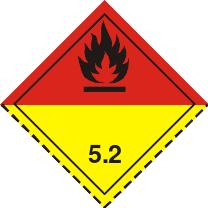
This label identifies organic peroxides, a class of substances that can burn rapidly, react dangerously or become unstable if exposed to heat or shock. The hazard profile varies widely, but the label signals a need to recognise both fire and decomposition risks during handling and transport.
It distinguishes these materials from other flammable or oxidising classes by emphasising their inherent instability. The label supports correct classification and segregation decisions rather than prescribing handling steps, which depend on the specific entry, packaging and conditions set out in ADR.
16. Model 6.1 toxic-substance label
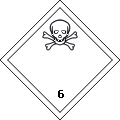
The Model 6.1 label denotes toxic substances that can cause serious injury or death if inhaled, swallowed or absorbed through the skin. Its skull and crossbones symbol provides an immediate visual cue of acute toxicity hazards.
In practice, this label differentiates toxic substances from other harmful classes by indicating direct health effects rather than flammability or corrosivity. The exact controls depend on classification, packaging and quantity, with the label forming one part of the broader identification system under ADR.
17. Model 6.2 infectious-substance label
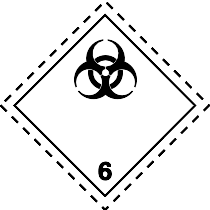
This label is used for infectious substances known or reasonably expected to contain pathogens capable of causing disease in humans or animals. It highlights a biological hazard rather than a chemical one.
Its operational role is to distinguish infectious materials from other toxic hazards, prompting attention to containment and exposure risks. The classification and packaging requirements depend on the category and nature of the pathogen, with the label serving as a clear identifier in transport documentation and handling.
18. Model 7A Category I-WHITE label
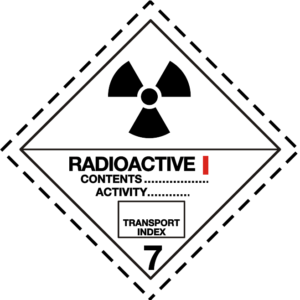
The Category I-WHITE label identifies radioactive packages with the lowest external radiation level among the three standard categories. It indicates that radiation levels are limited and controlled within defined thresholds.
This label distinguishes lower-risk radioactive consignments from Categories II and III. The categorisation is based on measured radiation levels, and the label forms part of a structured system used alongside documentation and other markings to communicate radiological risk.
19. Model 7B Category II-YELLOW label
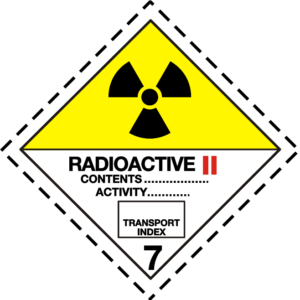
The Category II-YELLOW label applies to radioactive packages with higher external radiation levels than Category I. It includes a transport index and signals an increased level of control compared with the white category.
This label introduces the concept of a transport index, which reflects radiation intensity at a specified distance. It distinguishes intermediate-risk packages and supports decisions around handling and stowage within the broader ADR framework for radioactive materials.
20. Model 7C Category III-YELLOW label
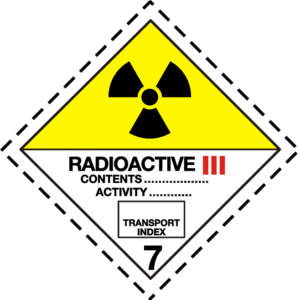
This label is used for radioactive packages in Category III-YELLOW, the highest of the three radioactive package categories. Classification is determined from both the surface dose rate and the transport index, within prescribed limits.
It indicates a more significant radiological hazard than Categories I and II. The distinction lies in the higher radiation levels permitted within this category, requiring careful interpretation of both the transport index and associated controls. The label marks the upper tier within the radioactive classification system without specifying operational measures in isolation.
21. Model 7E fissile label
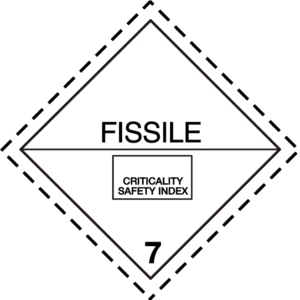
The fissile label identifies consignments containing fissile material, which can sustain a nuclear chain reaction under certain conditions. It includes the criticality safety index, an important numerical value for transport safety.
This label is distinct from the standard radioactive category labels by focusing on criticality risk rather than radiation level alone. It supports safe transport arrangements by signalling the need to consider spacing, accumulation and control measures defined elsewhere in ADR.
22. Model 8 corrosive-substance label
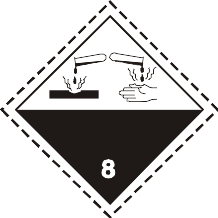
The Model 8 label indicates corrosive substances that can severely damage living tissue or corrode metals. The imagery highlights both human injury and material degradation risks.
Its operational distinction lies in identifying substances that cause chemical destruction rather than fire, toxicity or reactivity alone. The label informs handling awareness, with the precise requirements governed by the substance classification and packaging provisions in ADR.
23. Model 9 miscellaneous-dangerous-goods label

This label is used for miscellaneous dangerous goods that present hazards not covered by other classes. It acts as a catch-all category for varied risks that do not fit standard classifications.
These goods are distinguished by exclusion rather than a single hazard type. The specific risk depends on the substance or article involved, and the label works alongside proper classification to ensure appropriate identification in transport.
24. Model 9A lithium/sodium-ion battery label

The Model 9A label applies to packages containing relevant lithium-ion, lithium-metal and sodium-ion batteries. It identifies a specific subset of Class 9 goods associated with electrical energy storage risks.
A key distinction is that this is a package label rather than a placard. For placarding purposes under ADR, Model 9 is used instead of Model 9A. This separation helps avoid confusion between package-level identification and larger transport unit markings.
25. Environmentally hazardous substance mark

This mark, showing a dead fish and tree, identifies substances hazardous to the aquatic environment. It applies to packages where environmental risk is a relevant classification factor.
ADR 5.2.1.8 includes an exception for single and combination packagings where single or inner packagings contain no more than 5 litres for liquids or 5 kg net mass for solids. The mark distinguishes environmental hazards from human health or physical hazards and is used in combination with other required labels where applicable.
26. Battery mark
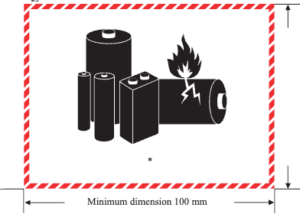
The battery mark is a red-hatched rectangular package mark used for certain battery consignments. It includes the applicable UN number and is applied under relevant special provisions, including those introduced for sodium-ion batteries in ADR 2025.
Its role is to identify packages that may not require a full hazard label but still need clear recognition due to their electrical and chemical characteristics. The exact use depends on the applicable special provision rather than a single universal rule.
27. Package orientation arrows

These arrows indicate the correct upright position for certain packages, particularly liquid combination packagings, cryogenic receptacles and specified machinery or apparatus. They must appear on two opposite vertical sides.
The mark distinguishes packages where orientation is critical to safety or integrity. ADR includes defined exceptions, so not all liquid packages require arrows. Their use supports correct handling without replacing the need for proper packaging and closure.
28. Limited quantity package mark

This black top-and-bottom diamond mark identifies packages carried under the limited quantity provisions. It signals that the goods are subject to reduced regulatory requirements compared with fully regulated dangerous goods.
The mark is normally 100 x 100 mm but may be reduced to at least 50 x 50 mm where package size requires. Its presence distinguishes limited quantity consignments from fully regulated packages while still maintaining a recognisable hazard communication system.
29. Limited quantity air-transport mark

This mark uses the same diamond design as the standard limited quantity mark but includes a central “Y”. It indicates compliance with air transport requirements under the ICAO Technical Instructions.
ADR accepts this mark for qualifying packages, allowing consistency across modes. The distinction lies in its recognition of air transport conditions, while still functioning within the ADR framework for road carriage when the criteria are met.
30. Limited quantity vehicle/container mark
This marking uses the same graphic as the limited quantity package mark but at a larger scale, normally at least 250 x 250 mm. It is applied to vehicles or containers in specific circumstances.
Its use is limited to the thresholds and conditions set out in ADR 3.4.13 to 3.4.15. The distinction is that it applies at the transport unit level rather than the package, signalling aggregated limited quantity loads rather than individual packages.
31. Excepted quantities mark
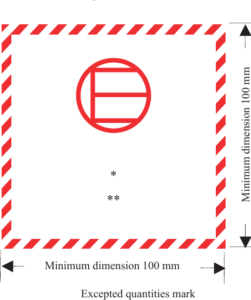
The excepted quantities mark is a hatched square, normally at least 100 x 100 mm, used for very small quantities of dangerous goods carried under simplified provisions. It includes the first or only label number.
Where required, it also shows consignor or consignee details. The mark distinguishes these consignments from limited quantities by indicating a different regulatory regime with its own conditions, rather than simply a reduced form of standard requirements.
32. OVERPACK mark
The OVERPACK mark uses the exact word “OVERPACK” and must be applied when packages are placed into an overpack and the marks and labels on the individual packages inside are not visible from the outside. The lettering must be at least 12 mm high and clearly legible. It identifies an overpack containing packages whose required marks and labels are not visible from the outside.
In practice, this mark often appears on shrink-wrapped pallets, cages or similar consolidated loads. It does not replace the underlying package labels or marks; those must still be correct and present on the inner packages. The requirement arises from ADR Chapter 5.2, and whether it applies depends on how the load is assembled and presented for carriage.
33. SALVAGE mark
The SALVAGE mark consists of the exact word “SALVAGE”, with lettering at least 12 mm high, applied to salvage packagings, large salvage packagings and salvage pressure receptacles. These are used to contain damaged, defective, leaking or non-conforming dangerous goods packages so they can be moved safely.
This mark signals that the packaging is not a standard transport package but a containment measure for an abnormal situation. It helps emergency responders and operators understand the context of the contents without implying any change to the classification of the goods themselves. The marking sits alongside any other required identification relevant to the contents.
34. Fumigation warning mark

The fumigation warning mark is a black-on-white sign of at least 400 x 300 mm, displayed at each access point of a fumigated cargo transport unit. It indicates that fumigant gases are present and that entry may be hazardous.
The mark must remain in place until the conditions for removal under ADR are met. This is a temporary but critical safety measure and applies to fumigated cargo transport units generally, including those fumigated before transport. The timing of removal depends on ventilation and safety verification, rather than simply the end of a journey, and must be managed carefully by those responsible for the unit.
35. Asphyxiation warning mark

The asphyxiation warning mark is at least 150 mm wide by 250 mm high and is placed at access points where there is an actual asphyxiation risk from substances such as dry ice or other coolants and conditioners. It warns that oxygen levels may be reduced inside the space.
This marking is only required where the conditions specified in ADR are met, particularly where enclosed spaces could present a genuine hazard to personnel. It is not a general requirement for all temperature-controlled loads. Operators need to assess whether the marking provisions apply based on the substance, packaging and ventilation characteristics of the unit.
36. Elevated-temperature substance mark
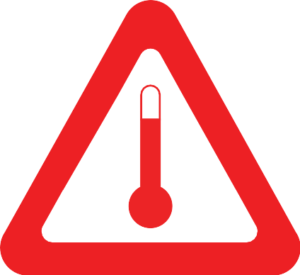
The elevated-temperature substance mark, often recognised by its red thermometer symbol within a triangular format, is used on tanks, vehicles and containers carrying substances at high temperatures. It applies to liquids at or above 100°C and solids at or above 240°C, where ADR specifies the requirement.
This mark highlights a physical hazard rather than a chemical classification alone. It informs handlers and emergency services that contact or proximity could cause burns or other thermal injuries. Its use depends on the carriage conditions and thresholds defined in ADR, rather than simply the identity of the substance.
37. Plain orange plate

The plain orange plate is a reflectorised orange panel displayed at the front and rear of vehicles when ADR requires it. The standard size is 400 x 300 mm, although reduced dimensions are permitted where there is insufficient space to fit the standard plate.
These plates indicate that the vehicle is carrying dangerous goods above certain thresholds, but they do not themselves identify the specific hazard. Their use depends on exemptions, load size and carriage type. In some cases, vehicles may not require plates at all, so the decision to display them must be based on the applicable ADR provisions.
38. Numbered orange plate
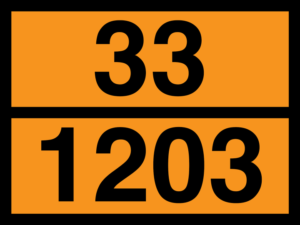
The numbered orange plate builds on the plain version by including a hazard identification number (top) and a UN number (bottom). The figures are black, 100 mm high with a 15 mm stroke, and are used for certain tank and bulk carriage operations where more detailed identification is required.
This format allows emergency responders to identify both the nature of the hazard and the specific substance involved. It is not used for all dangerous goods transport, and its application depends on the carriage mode and packaging type. The numbers must match the substance carried so that emergency responders can identify it correctly.
39. Model 7D radioactive placard
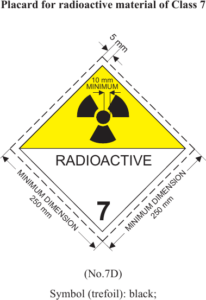
The Model 7D radioactive placard is an enlarged placard used for the carriage of radioactive materials. It is distinct from the three package-category labels used on individual packages and serves as a vehicle, container or tank-level indication under ADR requirements.
This placard forms part of a specialised regulatory framework for Class 7 goods. Its use depends on the category and type of radioactive material being transported, along with the configuration of the load. It must not be confused with package labels, which have different formats and purposes within ADR Chapter 5.2.
40. GB domestic Hazchem/Emergency Action Code panel
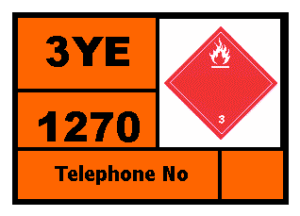
The Hazchem or Emergency Action Code (EAC) panel is a GB domestic arrangement used on tank vehicles for journeys within Great Britain. It typically displays an EAC, UN number, contact telephone number and, where applicable, a hazard diamond, forming part of the national system under the Carriage of Dangerous Goods regulations.
For GB domestic tank journeys, CDG permits these national panel arrangements in place of certain ADR vehicle markings. The panel is not an ADR model label and does not substitute for ADR requirements on international carriage. Operators must distinguish between domestic and international regimes and apply the appropriate system for the journey concerned.
Common ADR signs mistakes to avoid
- Confusing package labels with placards or vehicle plates, and applying the wrong format.
- Using outdated or non-compliant designs sourced informally online.
- Failing to display an OVERPACK mark when inner package markings are hidden.
- Applying orange plates when exemptions mean they are not required, or omitting them when they are.
- Incorrect or inconsistent UN numbers or hazard identification numbers on numbered plates.
- Leaving temporary warning marks, such as fumigation signs, in place longer than required.
- Treating UK Hazchem panels as a substitute for ADR markings on international journeys.
ADR separates identification requirements into functional groups with different trigger conditions. Package labels, vehicle placards, orange plates and warning marks should not be treated as interchangeable.
Another common issue is over-reliance on precedent. Just because a vehicle or package was marked a certain way on a previous job does not mean the same approach is valid for a different classification, quantity or journey. Each consignment should be assessed on its own parameters.
A practical pre-journey check
- Confirm the classification, UN number and packing group of the goods.
- Check whether quantities or exemptions affect marking requirements.
- Identify whether packages, overpacks or bulk/tank carriage are involved.
- Verify all required package labels and marks are present and visible.
- Assess whether placards, orange plates or special warning marks are required.
- Confirm dimensions, wording and legibility meet ADR specifications.
- Ensure any temporary marks (e.g. fumigation) are correctly managed.
- Document the check as part of internal compliance procedures.
Frequently asked questions about ADR signs
Are ADR signs all the same?
No. ADR distinguishes between package labels and marks, vehicle and container placards, and special warning marks. Each category serves a different purpose and is governed by different rules. Referring to all of them as “ADR signs” is common in practice, but it obscures important distinctions that affect compliance.
Which edition is current?
ADR 2025 is the current edition and has applied since 1 January 2025. In Great Britain, the Carriage of Dangerous Goods and Use of Transportable Pressure Equipment Regulations 2009, as amended, provide the domestic legal framework and refer to ADR for detailed requirements.
Do all dangerous-goods vehicles need orange plates?
No. Orange plates are only required when ADR thresholds and conditions are met. Limited quantity provisions, exemptions and certain carriage types may remove the requirement. The decision must be based on the specific load and journey, not a general assumption.
Can Model 9A be used as a vehicle placard?
No. Model 9A is a package label for lithium batteries and is not a vehicle placard. Vehicle placards follow ADR Chapter 5.3 formats and must not be substituted with package labels, even if the hazard class appears similar.
Is a Hazchem panel part of ADR?
No. The Hazchem or Emergency Action Code panel is a GB domestic arrangement. It is not an ADR model label and does not replace ADR requirements for international transport. Operators must apply ADR markings where ADR applies.
Can signs be copied from a website and printed?
Not safely as a compliance approach. Dimensions, colours, reflectivity and durability all matter under ADR. Informal copies may not meet the specification. It is better to source compliant markings or verify against ADR requirements before use.
Who should check a load-specific requirement?
Responsibility should be allocated to competent persons within the operator’s organisation, with Dangerous Goods Safety Adviser (DGSA) input where the DGSA requirements apply. Where uncertainty remains, seek competent advice; you can request guidance via https://www.operatorlicence.co.uk/contact-consultation/.
What should be done when classification or marking is uncertain?
Do not rely on assumptions. Verify the classification and the applicable ADR provisions, then escalate the question internally or to a DGSA where relevant. Resolve uncertainty before carriage begins.
Official sources and further reading
The following sources reflect the underlying regulatory framework and guidance. They are provided for transparency and cross-checking against ADR 2025 and GB domestic requirements.
- https://www.hse.gov.uk/cdg/manual/adrcarriage.htm
- https://www.hse.gov.uk/cdg/manual/consignment.htm
- https://www.hse.gov.uk/cdg/faqs.htm
- https://www.hse.gov.uk/cdg/manual/packaging.htm
- https://www.hse.gov.uk/cdg/manual/crew.htm
- https://www.gov.uk/shipping-dangerous-goods/what-are-dangerous-goods
- https://www.gov.uk/government/publications/adr
- https://www.gov.uk/guidance/the-highway-code/vehicle-markings
- https://unece.org/transport/documents/2025/01/standards/adr-2025-volume-2

